Why Your YouTube Views Are Flat: The Silent Phase Almost Every Creator Goes Through
I published nearly twenty videos in a row that almost nobody watched.
Every one of them had work in it. Thumbnails redone past midnight. Openings rewritten four times. Retention checked section by section. Each time I finished one I thought, this is the one that goes.
Then the numbers came in. Dozens of views. Sometimes a few hundred. It is very easy, in that stretch, to conclude that the platform is not for you.
Looking back, I understand what that period actually was. This is not a game won by the smartest person in the room, or the one with the best camera. It is won by whoever can keep learning from data while their feelings are telling them to stop.
What nobody mentions at the start
Most people begin with a fairly reasonable set of assumptions. Publish and views follow. Stay consistent and subscribers accumulate. Make something good and it spreads on its own.
Reality is messier. There are months where views climb, videos get recommended and everything feels like it is working. There are also months where views fall, new uploads land quietly, and the whole thing feels stalled.
This is not a small-channel problem. Established creators go through the same cycles. They just do it with a bigger buffer underneath them.
Why a new channel gets few views
This part is normal, and understanding why makes it much easier to sit through.
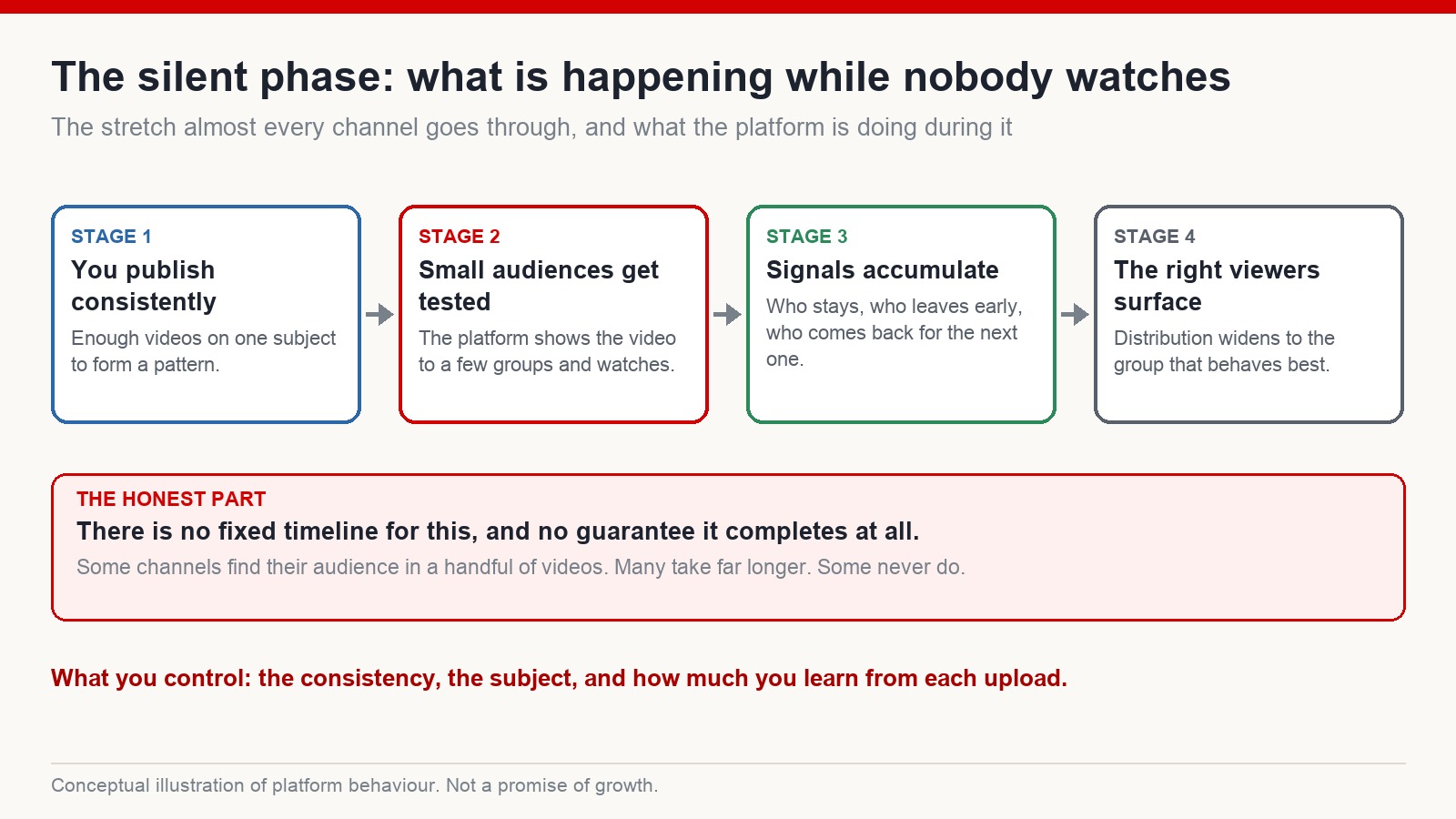
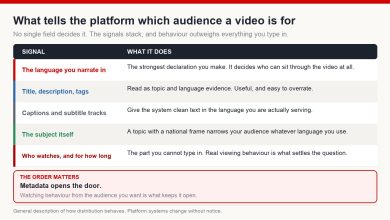
Early on, the platform is still working out what your channel is. What subject it belongs to. Which group of people care about it. Who watches to the end and comes back for the next one.
It gathers that by showing your videos to small groups and watching what happens. There is no fixed schedule for it. Some videos are understood quickly. Some channels publish dozens before the right audience surfaces. And some never complete the process at all, which is worth saying plainly rather than pretending otherwise.
What you control is the quality of the signal you send. Consistent subject matter, consistent format, videos that give the system something clear to work with.
The biggest mistake: publishing on instinct alone
A lot of creators make what they feel like making. What they want to talk about. What they think is interesting.
None of that is wrong, and a channel with no personal investment in it is miserable to run. But the person deciding whether the video keeps playing is the viewer, not you. If the topic does not meet a real need, or is not compelling to the specific group you are aiming at, it will struggle regardless of how well it is made.
The workable position is somewhere in the middle: subjects you can stand to spend a year on, framed around something people actually want.
Do not start in a wide niche
The other common opening mistake is choosing a subject that is far too big.
Motivation. Lifestyle vlogging. General news. Popular games. In those categories you are competing with channels that have been running for years, with production teams and loyal communities already in place.
Go narrower. Instead of artificial intelligence, make videos about AI for video creators. Instead of personal finance, make videos about managing money as a freelancer. The clearer the subject, the easier it is for both the platform and a passing viewer to work out what your channel is.
Do not ignore how the platform reads your video
Some videos are genuinely good and still get very little reach. One frequent reason is that there is not enough information for the system to place them.
Keep the signals consistent across the title, the description, the captions, the spoken words, chapters where they help, and tags where they are relevant. Not stuffed. Consistent. A video whose title, narration and description all point at the same subject is much easier to classify than one where each element says something slightly different.
This does not make anything go viral. It makes it more likely that the right people are the ones being shown it.
Should you buy a channel that is already monetised?
It looks like a shortcut. It usually is not.
If the channel previously served an audience with nothing in common with the content you plan to make, early performance can be worse than starting clean. The existing subscribers are not interested in the new subject, and their lack of response is itself a signal.
If you are still considering it, look hard at the content history, where the viewers came from, and how closely the old subject relates to the new one. Bear in mind there are also policy risks around transferred channels, and that you are buying an asset whose past you cannot fully verify. Often building from zero is both simpler and more durable.
When views go flat, stop reading the view count
The real danger in a quiet stretch is not the number. It is losing the will to keep going.
The low-view period is usually when creators learn the most, provided they are looking at the right things.
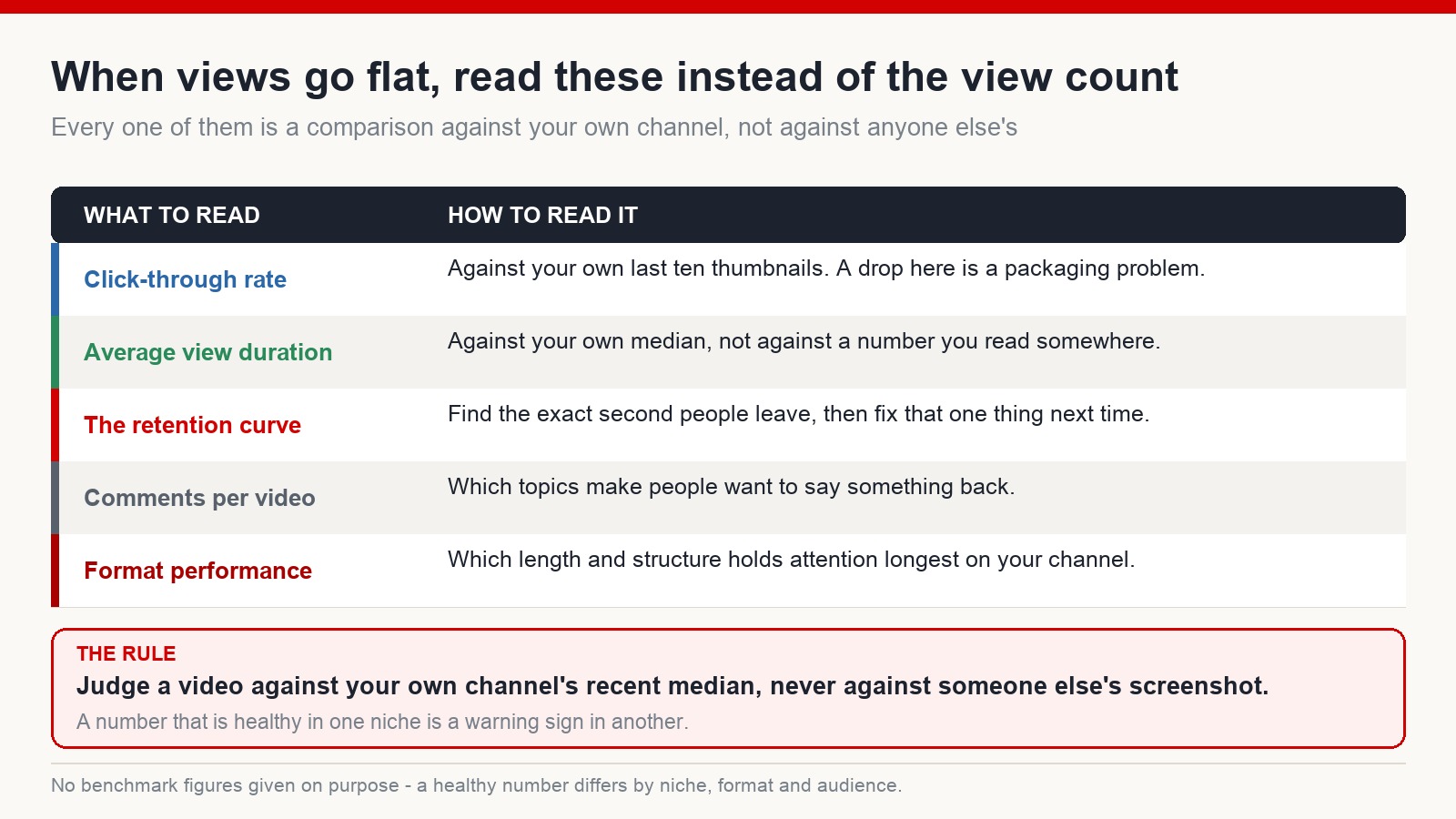
Which thumbnails earn clicks, relative to your own recent ones. Which openings hold people past the first thirty seconds. Which topics make viewers want to reply. Which format and length keeps attention longest on your channel specifically.
Notice that every one of those is a comparison against yourself. I would avoid benchmark figures you find online entirely. A number that indicates health in one niche is a warning sign in another, and comparing your channel to a screenshot from someone else’s is a good way to draw the wrong conclusion twice.
Every upload is a test. Every test tells you something about your audience. That is what the quiet period is for.
Do not try to invent from video one
Wanting to be different is a good instinct that arrives too early for most people.
If you do not yet understand how a video holds attention, originality slows the learning down. Watch successful videos in your field and take them apart. How does the opening work? How does the pace move? How is the information ordered? Where does it turn? How does it end?
Learn the structure and the thinking behind it. The distinctive style comes after, built on ground you have tested. Nearly every large creator went through this order, whether or not they describe it that way.
Emotion arrives before information
A common assumption is that more information makes a better video. In practice viewers decide to stay for emotional reasons and then absorb the information as a by-product.
The videos that hold people usually move through a sequence: curiosity, then tension, then recognition, then some form of resolution. An opening like “there is one mistake that keeps a lot of creators stuck, even when they publish every week” works because it opens a loop. The viewer wants to know what the mistake is. That is all a hook has to do.
Do not wait for perfect
This is the trap that costs the most time. The thumbnail gets redone. The script gets rewritten. The edit is never quite right. Nothing is published.
Creators who improve quickly have one thing in common: they keep testing. Every upload checks a topic, a thumbnail, an opening, a retention curve. This is a game of continuous learning, not a game of getting it right first.
If your channel is quiet today, that is not evidence you cannot do this. Almost everyone passes through the same stretch. The difference is rarely who avoided failing; it is who kept publishing while the results were disappointing.
Common questions
Is it normal for a new channel to get no views?
Yes. Most channels need time before the platform and the audience understand what they are. A quiet opening stretch is very common.
How long before videos start getting recommended?
There is no fixed timeline. It depends on the subject, how competitive it is, how viewers respond, and how each individual video performs. Anyone quoting you a specific number of weeks is guessing.
Should I delete videos with low view counts?
Usually not. Older videos are sometimes picked up again later when they match what someone is looking for. Deleting also removes the evidence of what you have already tested.
Are flat views always the platform suppressing my channel?
Rarely. Falling views more often come from a topic that is not landing, a low click-through rate, weak retention, or a shift in what the audience wants. Those are all things you can act on.
How many videos should I judge myself on?
Not one. Look at patterns across a run of uploads. A single video tells you almost nothing; ten tell you where you actually stand.
What I would tell my earlier self
Do not measure the whole journey by one video. Measure it across a hundred.
The platform changes, the recommendation systems change, and most of the advice you read expires. What has held up is unremarkable and hard: keep learning, keep fixing the specific thing that went wrong, and keep publishing.
The video after the quiet stretch is often the one that changes the shape of the channel. You do not get to see it if you stop first. If you want to see how I approach building faceless channels for English-speaking audiences, that is what I work on at mmoyoutube.com.